Trading Psychology and Discipline: Rules That Hold
Revenge trading, overtrading after a win, fear of missing the move, and the journal habit that fixes all three. Discipline rules for fast expiry traders.

Accounts are usually lost in the ten minutes after a loss, not during the trade itself. The trade was a decision you made while you were calm. The next three were decisions made by someone who wanted their money back.
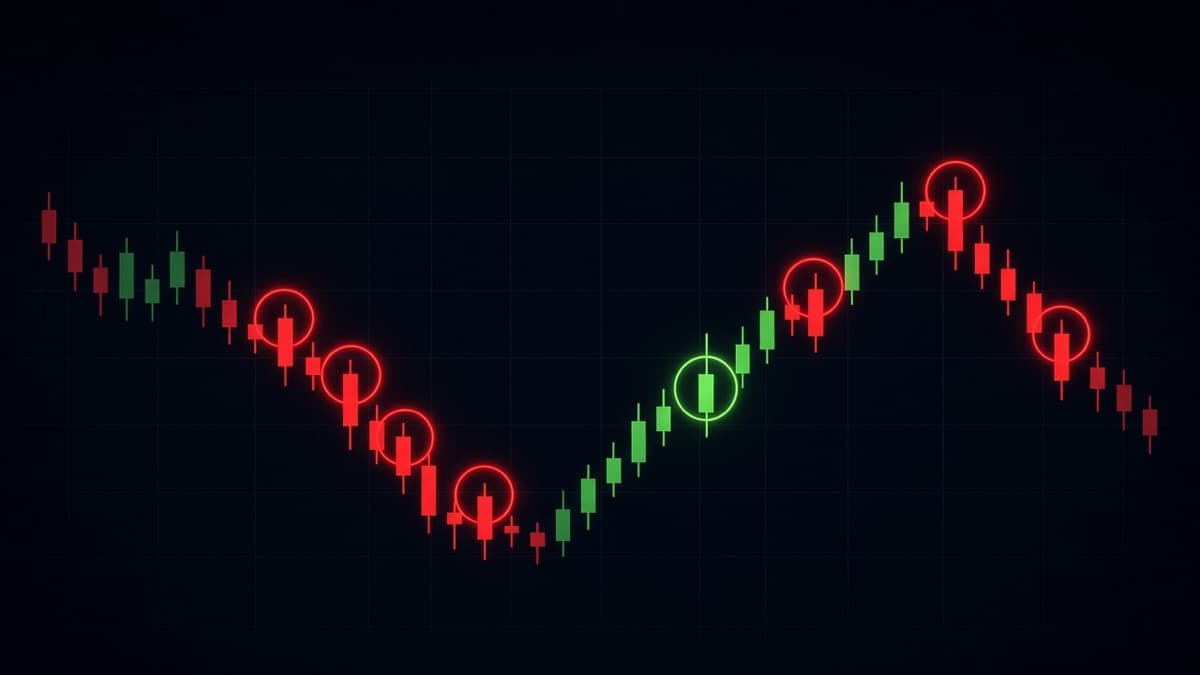
That chart is the most common shape in trading. Not a crash, not one disaster, just a good day that was not allowed to end. The trader did not lose to the market. They lost to the fact that the platform was still open.
Why does discipline break at a specific moment?
Because the rules you need are always required at the exact moment you are least able to apply them. Right after a loss, your judgment is worse and your urgency is higher. Right after a win, your caution is lower and your sense of what is normal has moved.
So discipline is not willpower, it is scheduling. Every rule worth having gets decided before the session, written in cash rather than percentages, and made hard to renegotiate. The three failures below all have the same structure: a decision that should have been made in advance was made in the moment instead.
Revenge trading: what it looks like on the chart
Look at the sequence. The first trade was fine. A rejection candle at a level, a reasonable read, and it lost, which happens to good trades roughly 45 percent of the time. Then price kept going up, and instead of leaving it, the trader shorted again, higher, bigger, with no new reason except the last result.
That second entry is the worst price on the chart. It is not a coincidence. Revenge entries are systematically taken late into whatever just hurt you, because the reason for the trade is the previous trade rather than the market.
How to spot it in yourself
Two measurements, both in your journal:
- Time since the last trade. Revenge trades cluster within a minute or two of a loss. If your log shows several entries a couple of minutes apart, you already know what those were.
- Stake relative to the previous one. Any increase that was not planned is the signal. Doubling after a loss is a staking plan, and the maths of why it fails is in risk management for binary trading. Tripling after a loss is not even a plan.
There is a third tell that does not go in a journal. If you cannot say what your reason was in five words, there was not one.
The fix, which is mechanical
- Lock the stake as a cash number before the session. Ten dollars, written on paper next to the screen, not a percentage you can recalculate.
- Five minute cooldown after every loss. Set a timer. No chart watching, get up.
- Three losses and the platform closes for the day. This is the rule that actually saves accounts.
- One reason per trade, written before you click. If the reason box is empty, the trade does not happen.
None of that requires you to be calm. That is the point. Rules that require you to be calm fail precisely when you need them.
Overtrading: the win that turns into a loss
Overtrading after a win is subtler than revenge trading because nothing feels wrong. You are right, the chart is making sense, the results are coming, so you keep going. Two things quietly change.
The stake drifts up. Money won a few minutes ago does not feel like your money yet, so risking it feels cheap. A 2 percent rule becomes 3 percent, then 5, and nobody decided that.
The standards drift down. After four wins you stop waiting for the level, and you start taking the setup that looks roughly like the ones that worked. The last five trades of a good session are usually the loosest trades of the day.
The fix is a profit rule that mirrors the loss rule. Pick one:
- Trade count cap. Six trades, then done, win or lose.
- Session target. Up 4 percent and the platform closes.
- Best trade rule. After your best result of the day, one more trade maximum.
Any of the three works. What does not work is an open-ended session with a vague intention to be careful, because careful is not a mechanism.
FOMO: fear of missing the move
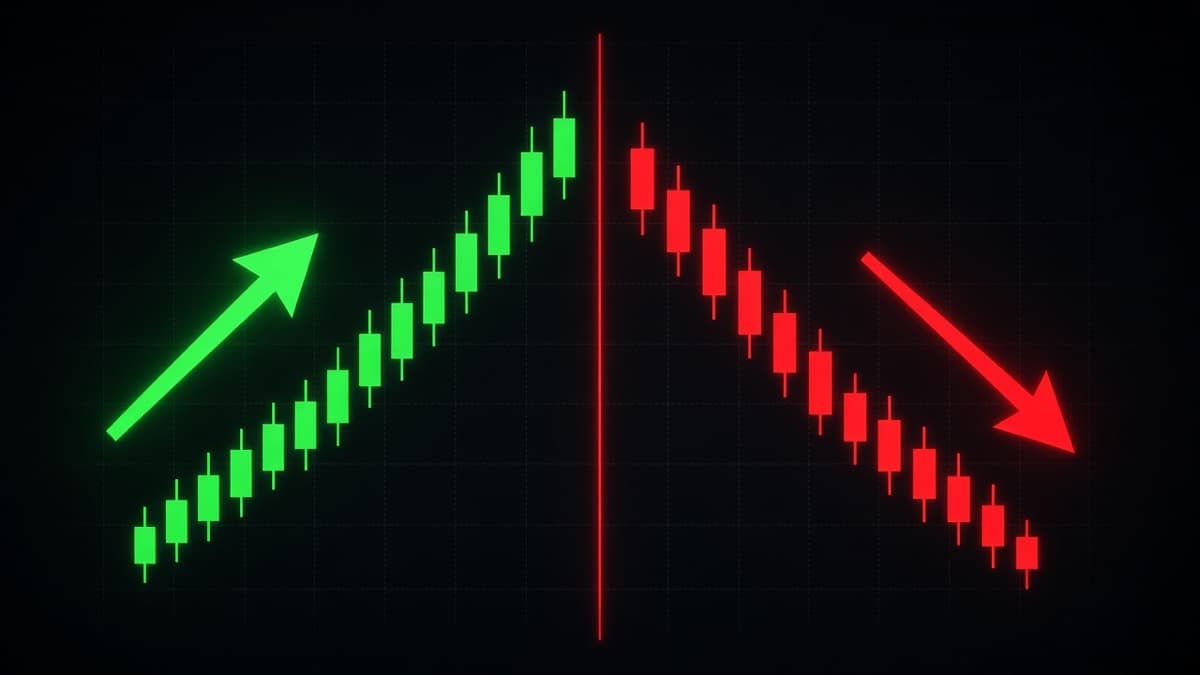
FOMO trades have a fingerprint: you enter at the close of the candle that already moved. The reasoning feels sound in the moment, because price is clearly going your way, and it is the single worst moment to buy on a short clock. The move has just happened, the participants who wanted in are in, and the most likely next event is a pullback that settles your trade against you.
The long upper wick on a candle like that is not an abstraction. It is a chart of people buying too late. Understanding what that candle is telling you is a useful antidote to being in it, and the mechanics are covered in hammer and shooting star.
Three things that reduce it
- Trade the retest instead. If the break is real, price usually comes back to the level it broke. That entry has a defined invalidation point and it is not chasing anything. The structure behind it is in chart patterns complete guide.
- Count the candles. If the move is already four or five candles old, the short expiry trade is gone. Not risky, gone. The timing version of this argument is in binary options expiry times explained.
- Write the missed setup in your journal as if you took it. Include what it would have needed for you to be in on time. After a dozen of those you stop feeling the loss of a missed move, because you can see how often the late entry would have failed.
The deeper fix is arithmetic. On any single pair there are dozens of readable setups in a week. The one you missed is worth 2 percent of your balance at most. The trade you take to compensate for missing it can cost several times that.
Why the first loss of the day matters most
The third loss gets the attention because that is where the limit sits. The first one decides everything. What you do in the two minutes after the first loss sets the pattern for the session, and almost nobody has planned for it.
Write the response down in advance, as a sequence, not a sentiment:
- The trade settles as a loss.
- You write the row in the journal, including the reason you gave before entering.
- Timer, five minutes, away from the screen.
- You come back and read your stake number off the paper.
- The next trade needs a reason written before the click, same as every other trade.
That is it. Five steps, all of them boring, and they interrupt the only sequence that actually damages accounts: loss, immediate re-entry, bigger size, second loss, much bigger size.
There is a second reason the first loss matters. Your win rate says losses arrive in clusters. At a 55 percent win rate, three in a row happens roughly once in every eleven trades, so on a six trade day it is a normal Tuesday rather than a signal that anything is broken. If you treat the first loss as information about your ability, you will change something that was working. Treat it as the cost of doing business, because arithmetically that is what it is.
Trading with money you actually need
Everything in this article gets harder by an order of magnitude when the money matters. If the stake is rent, the five minute cooldown does not happen, the loss limit gets renegotiated, and the size goes up because you need a specific number by Friday. No rule set survives that pressure, which is why it belongs in a psychology article rather than in a risk one.
The only fix is upstream. Trade money whose loss changes nothing about your month. Never trade borrowed money or credit. That is the same language REDBERRY puts on the about page, and it is there because the desk cannot help someone who needs a guaranteed outcome, and nobody can offer one.
A practical test: if you would be uncomfortable telling someone close to you exactly what you have at risk, the size is wrong. Not the strategy, the size.
Why demo accounts do not train discipline
A demo account teaches you the buttons and nothing else. The behaviour you need to practise is what you do after losing real money, and losing pretend money does not produce it. This is also why the REDBERRY desk rules say to take signals on a Live broker account rather than the broker demo: demo and Live results differ, and the difference is mostly you.
If you want to practise the discipline side without meaningful risk, use the smallest stake your platform allows on a Live account. A $1 trade produces the same behavioural sequence as a $50 trade, at one fiftieth of the cost. What you are rehearsing is the cooldown, the journal row, the stop, and the refusal to size up. Those habits transfer. The comfortable feeling of a demo win does not.
Run it for two weeks at minimum size, then read the journal. If you broke the loss limit at $1 stakes, you will break it at $20 stakes, and the sensible conclusion is to fix the rule before raising the size.
Tilt, and the signs that come before it
Tilt is the state where you are still clicking but you are no longer reading. It has physical signs that arrive before the bad trades:
- You are on a timeframe you do not normally trade.
- You have opened a pair you do not know, often OTC, because your usual one is quiet.
- You are watching the balance rather than the chart.
- You have stopped writing in the journal. This one is almost diagnostic. People stop logging at exactly the moment the log would be most useful.
The intervention has to be physical, not mental. Stand up, leave the room, ten minutes minimum. The market will still be there. If two of those signs are present, the day is finished whether or not you have hit your loss limit.
The journal: the cheapest edge available
Most traders who have been losing for six months cannot tell you their win rate by expiry. They have an impression. An impression cannot be fixed because it cannot be measured.
Nine columns is enough:
| Column | Why it is there |
|---|---|
| Date and time | Finds your good and bad hours |
| Pair | Some pairs suit your reading, some do not |
| Expiry | The column that usually explains the losses |
| Direction | Catches a directional bias you did not know you had |
| Stake | Shows size creep in black and white |
| Reason, five words | If you cannot write it, do not take it |
| Result | Win, loss or refund |
| Payout percent | Needed to work out your break-even |
| Confidence, 1 to 3 | Tests whether your certainty means anything |
After fifty rows, sort it and look.
That chart is made up to show the shape, not to tell you what your hours look like. But the pattern it shows is the normal outcome of the exercise: two or three hours where you are clearly above your break-even line, and a lot of hours where you are feeding the account back. The fix in that case is not a new indicator. It is trading four hours a week instead of twenty.
The same sort applied to expiry answers a different question. If your 1 minute trades run at 48 percent and your 5 minute trades on the same setups run at 58 percent, you now have a decision that makes itself, found in your own data rather than in an article.
Review cadence that works: five minutes at the end of each session to fill gaps, twenty minutes at the end of the week to sort and count. Anything more ambitious than that does not get done.
Stopping for the day
The hardest rule and the one that matters most. Three losses, or 6 percent down, and you are finished until tomorrow.
The reason is arithmetic rather than character. Down 6 percent needs plus 6.4 percent to get level, which is an ordinary week at 1 to 2 percent risk. Down 30 percent needs plus 42.9 percent. Down 50 percent needs plus 100 percent. The limit is not about the money you save today, it is about never being in the third row.
Two details that make it stick:
- Close the platform, do not just stop clicking. Watching the market after a loss limit is how the limit gets renegotiated.
- Write the reason for stopping in the journal. One line. It becomes evidence next time you want to argue with the rule.
There is a version of this built into the REDBERRY desk. If the Live balance falls below $10 the license ends on its own, and the notice on screen says the plain thing: losses happen, do not stop. The license comes back after a $50 Live deposit once the balance is $10 or more. It is a product rule rather than a psychology rule, but it lands in the same place: the account is what you are protecting, and there is no desk without it.
Boredom is a position size problem
Nobody warns you about the quiet hours. In the lull between the London close and the New York open, EUR/USD can sit in a three pip box for half an hour. Every candle is a small body with wicks on both sides, which is the chart plainly saying that neither side is in control.
Boredom trades are not driven by fear or greed. They are driven by having a platform open and nothing to do. The countermeasures are unglamorous:
- Trade a session, not a day. Pick two hours and be finished. Which pairs move in which hours is covered in forex pairs and trading sessions.
- Close the platform between setups. Alerts exist for this.
- Keep the trade count cap. If the cap is six and you have taken six, the day is done even if it is only 10am.
Two decent setups in a two hour session is a normal count. The hours where nothing sets up are part of the job, not a failure of the job.
What to do after a genuinely big loss
Different problem, different rule. A day where you broke your rules and lost 15 or 20 percent needs more than a cooldown.
- Stop for 24 hours. No charts, no desk, no analysis of what happened. Judgment does not come back in an hour.
- Write the sequence down the next day. Not how you felt, what you did. Trade by trade, with stakes. The sequence is almost always three or four decisions, each of which was a rule you already had.
- Come back at half size. One percent per trade until the balance is back to where the bad day started. This is a mechanical reduction, not a punishment.
- Change one thing, not everything. The instinct after a big loss is to rebuild the whole approach. The actual cause is usually a single missing brake.
Most blown accounts are not a strategy failure. They are one afternoon where the loss limit was ignored, and everything after that was consequence.
Other people's screenshots
A specific kind of damage comes from comparison. Someone posts a green day, a review shows a good week, a stats panel shows what a whole group of traders did today, and suddenly your careful $10 stakes feel pathetic. The next click is bigger and the reason is somebody else's number.
Three things worth remembering when that hits.
You are seeing the selected sample. Nobody posts the session where they broke their loss limit. Green screenshots are cheap to produce and impossible to verify, which is why REDBERRY labels its own homepage stats and reviews as illustrative rather than as a prediction of what you will get.
You do not know the size. A 40 percent day on a $50 account is $20 and a rule violation. The percentage tells you nothing about the process that produced it.
Your account has to be sized for your own tolerance, not for someone else's post. The trader running 10 percent stakes who is up this week is the same trader who will be down 80 percent after one losing run, and you will not see that post either.
The only comparison that helps is your own journal against itself. Last month's win rate by hour against this month's. That number belongs to you and it cannot be staged.
Rules that survive contact with a bad day
Some rules hold under pressure and some evaporate. The difference is whether they need you to be in a good state to work.
| Fragile rule | Version that holds |
|---|---|
| I will be careful after a loss | Five minute timer, then one trade maximum |
| I will not oversize | Stake written in cash on paper before the session |
| I will stop if it gets bad | Three losses and the platform closes |
| I will keep a journal | Journal open in a second window, row filled before the click |
| I will not chase | No entry after the third candle of a move |
Every rule in the right hand column is checkable by someone watching over your shoulder. That is the test. If a rule cannot be checked, it is an intention.
Where a signal desk helps, and where it does not
A desk removes one source of noise, which is the endless question of what to take. REDBERRY reads the TradingView API for realtime price and chart structure on Live pairs and calls the next minute, and on OTC it uses private Quotex API access for a live price feed with the same inbuilt strategies. That is fewer decisions than staring at a blank chart and inventing reasons.
What it does not do is remove the part of this article. Signals are not 100 percent accurate, so losing runs still arrive, and the desk cannot stop you from tripling your stake in the middle of one. The desk rules are deliberately about you rather than about the signal: Live account rather than broker demo, 1 to 2 percent per signal, at most one step of MTG. If you want the detail on how the desk is put together, REDBERRY AI bot explained covers it, and what is binary trading covers why the fixed payoff makes sizing so unforgiving in the first place.
The honest summary is that discipline is the only part of this you can guarantee. You cannot guarantee a read, a session, or a win rate. You can guarantee that the stake was $10, that you stopped after three losses, and that every row got logged. Do those three for a month and your results stop being a blur you interpret emotionally, and start being data you can act on. When you are ready for the list of specific chart situations that break these rules, common binary trading mistakes goes through them one by one.
Questions people ask
What is revenge trading and how do I stop it?
Revenge trading is taking a trade to win back money rather than because the chart offered something. The tell is the gap: the size goes up and the time since the last trade goes down. The fix is mechanical rather than emotional. Lock the stake as a cash figure before the session, put a five minute cooldown after any loss, and cap the day at three losses. You cannot talk yourself out of tilt while you are on tilt, so the decision has to be made beforehand.
Why do I lose money after a big win?
Because a win changes how the next stake feels. Money just made gets treated as a free bet, so the size drifts up and the standards drift down, and the trades taken in that mood are usually late entries into moves that already happened. Bank the win by closing the platform, or at minimum re-read your stake number off the page before the next click.
How do I deal with the fear of missing a move?
Accept that the trade is already gone and trade the retest instead. A move that has run five candles is the worst place to enter on a short expiry, because the most likely next event is a pullback. Write down what you would have needed to see to be in early, and wait for that condition next time. There are roughly a hundred setups a week on any pair, and missing one costs nothing.
What should a trading journal contain?
Date and time, pair, expiry, direction, stake, the reason in five words, the result, the payout percent, and one confidence number from 1 to 3. Nine columns. After fifty rows you can split your win rate by hour, by expiry and by pair, and the answer to what you should change stops being a matter of opinion.
How long should I stop for after hitting my loss limit?
The rest of the day, without exception. Not a shorter break, not smaller sizes, the rest of the day. A 6 percent hole needs a 6.4 percent gain to fill and that is a normal week. The hole you dig in the two hours after ignoring the limit is the one that takes months.
Does using a signal desk remove the emotional side?
It removes some of the decisions, not the discipline. REDBERRY gives you a call from a live feed and inbuilt strategies, and the signals are not 100 percent accurate, so you still choose the size, whether to take it and when to stop. The desk cannot stop you from tripling your stake after two losses. That part is still yours.
Nothing here is financial advice. Signals and setups can be wrong, so only risk money whose loss will not change your life.