Amixfx Bot vs Redberry AI Bot
Amixfx Bot compared with Redberry AI Bot on the question that decides everything: where the price comes from, and whether it matches the book you trade.
Ask any signal tool one question before you ask anything else: where does your price come from? Amixfx Bot is a reasonable place to run that question, because it is the question that decides whether a direction can be about the market you are actually trading. Everything else, the interface, the win screenshots, the speed of the arrow, sits downstream of it.
Amixfx Bot and the price source question
I have no public documentation for Amixfx Bot. No feed named, no method published, no maintainer I can verify. So I am not going to characterise what it reads, and you should be sceptical of any article that does.
What I will do is set out what a good answer looks like, so you can judge the reply you get.
A specific answer names a source. A data vendor, an exchange, a platform feed, something with a name that exists outside the product. "Advanced algorithms" is not a source. "Our servers" is not a source. "AI" is not a source, it is a description of what happens after the data arrives.
There is a second half that people forget. The source has to match the book you trade. If you are taking EUR/USD (OTC) on Quotex, that series is quoted by Quotex. A direction produced from interbank EUR/USD can be about a very similar path, and on a 15 second window a very similar path is not the same trade. The two series agree most of the time and disagree exactly when it costs you.
Three questions that separate a feed from an output
Short list, and you can put all three in one message to any supplier.
- Which feed, by name, and for which pairs? Live FX and platform OTC books are different data problems and a serious tool will say which it covers.
- How often does the price update? A short window is measured in ticks. A feed refreshing a few times a minute cannot see what a 15 second expiry is graded on.
- What does the tool refuse to promise? The honest answer includes a limit. If nothing is off the table, nothing has been thought through.
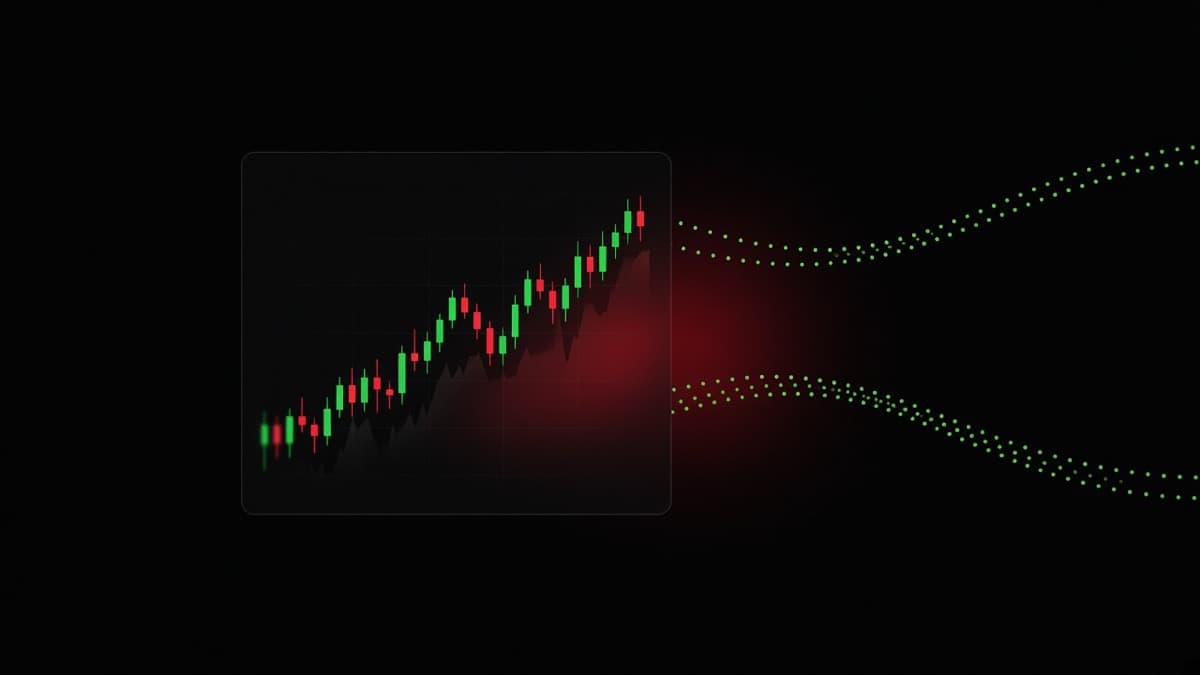
Question two is the one that gets waved away, and that diagram is why it should not be. Both lines are describing the same move. One of them can see the retracement a short expiry would have settled inside. The other cannot, and a direction produced from it will still look exactly like a direction produced from a live stream. You cannot see the difference in the arrow. You can only see it in the source.
What REDBERRY names
REDBERRY answers all three questions in public, which is the whole reason it can be compared with anything.
The Live side uses the TradingView API for realtime price and chart structure, so the algorithm can read the market, then inbuilt strategies predict the next move. Live is 17 FX pairs written with a slash, EUR/USD, GBP/JPY and the rest, and the generate time is always 1m. One market, one window, no ambiguity about what the call is for.
The OTC side uses private Quotex API access for a live OTC price feed, with the same strategies. That is the part that answers the matching problem above: when you take a signal on EUR/USD (OTC) on Quotex, the feed behind it is the Quotex OTC book rather than a lookalike series. Pair names on Quotex use EUR/USD (OTC), which Quotex trading guide sets out in full.
Two limits stated plainly. Signals are not 100 percent accurate, which is not the same as saying nothing is being read. And the feed credentials are internal server credentials, never issued to users, with no public order API and no SDK that places trades. The output is informational and you keep every decision. How REDBERRY generates Live and OTC signals has the scan sequence step by step.
Delay is part of the data question
Feeds get discussed as if the only issue is accuracy. The other half is when the price arrived.
Work through the timing of a single trade. The tool reads price and produces a direction. You read the direction. You switch to the platform, find the pair, set the amount, set the expiry, press up or down. On a one minute window, all of that has to fit inside the same minute the call was about, and every second spent hunting for an amount box is a second of the window you paid for and did not use.
Two things follow. First, a call that reaches you late is not the call that was produced, even if the arrow is identical, because your entry price is not the price it was read at. Second, the fix is preparation rather than speed: set the stake and the expiry before you generate, so the only action left is one tap on a direction.
There is a data version of the same point. If the price behind a call is a few seconds behind the market, a 15 second expiry is being decided partly by ticks the tool never saw. That does not make it worthless on a 5 minute window. It makes it unsuited to the very short end, and nobody tells you which end their feed can support unless you ask.
On REDBERRY the Live scan takes a few seconds and the window is a full minute, which leaves room to place properly if you have the stake set in advance. Entering at the start of a window rather than halfway through it is the single cheapest improvement available on either side of this comparison.
Amixfx Bot vs Redberry AI Bot side by side
| Criterion | Amixfx Bot | Redberry AI Bot |
|---|---|---|
| Named price source | None I can find published | TradingView API for Live, private Quotex API for OTC |
| Matches the OTC book you trade | Unknown, worth asking | Yes, the OTC feed is the platform's own book |
| Live pair cover | Unknown | 17 FX pairs, fixed 1m window |
| Timeframe control | Unknown | OTC timeframe locked before generate, from the platform list |
| Accuracy language | Unknown | Not 100 percent, stated before you unlock |
| Access to the raw feed | Unknown | None. Internal keys, no public order API |
| Support | Unknown | contact@redberrybot.com, usually one to two working days |
The left column is thin because the documentation is not there for me to read. If the team behind Amixfx Bot publishes a feed page, that changes and you should compare properly rather than take a blog's word for it.
Which one suits which trader
If you are comfortable evaluating a tool by behaviour alone, run it for fifty logged trades on one pair and one window, and judge the results rather than the description. Plenty of traders work that way, and it is defensible as long as the stakes are small while you learn what you have.
If you would rather know what is behind the arrow before you place a stake, use something that names its feed and tells you which book it read. That is what REDBERRY is set up to do, and About us covers the rest of the shape: a non-profit informational desk, not a broker, no funds held, no trades placed for you.
If short expiry trading is new to you, the feed question comes second and what is binary trading comes first, because the product decides how much any feed can help.
Trying the desk
Pick your platform, open the account through the Register button on that platform's card, fund at least $100 in a Live account, then submit the Trader ID. Quotex IDs are 8 digits under your email when you tap the balance. The licence key is 16 characters in groups of four and it opens that one platform.
After that the desk gives you tabs per platform, a Live tab on both, and the same three rules on the way in: Live account rather than the broker demo, 1 to 2 percent risk, one step of MTG. Keep the Live balance above $10, since below that the licence ends by itself and a $50 Live deposit reactivates the same key.
From the same series, Meeru Bot vs Redberry AI Bot deals with accuracy claims and how to measure one, and Chinese Bot vs Redberry AI Bot deals with tools that arrive as a shared file with no page behind them.
Questions people ask
Where does Amixfx Bot get its price data?
I have no public documentation for it, so I am not going to answer for them. Put the question to whoever supplies the tool and expect a specific answer: a named data vendor, an exchange, or a platform feed. If the reply is that the method is private, you are being asked to trust output you cannot inspect, which is a decision rather than a detail.
Is Amixfx Bot suitable for Quotex OTC pairs?
Only if its price comes from the same book you are trading. OTC series are quoted by the platform itself, so a direction produced from an interbank feed is about a different series than EUR/USD (OTC) on your screen. Ask which book the call describes before you match it to an OTC expiry.
What does Redberry AI Bot use for price?
Two named sources. Live pairs use the TradingView API for realtime price and chart structure, then inbuilt strategies predict the next move across 17 FX pairs with a fixed 1m window. OTC uses private Quotex API access for a live OTC price feed, with the same strategies on the pair and timeframe you lock.
Does a named feed mean the signals always win?
No, and Redberry says so: signals are not 100 percent accurate. A named feed removes one unknown, which is whether the tool was reading the market you are trading. It does not remove the market. Sizing at 1 to 2 percent exists because correct reasoning still produces losing trades.
Can I see the Redberry API keys or connect my own bot to the feed?
No. The platform and TradingView credentials are internal server keys, they are never issued to users, and there is no public order API or partner SDK. The desk output is informational: you read UP or DOWN and decide what to do on your own broker account.
Nothing here is financial advice. Signals and setups can be wrong, so only risk money whose loss will not change your life.